Showing posts with label interview. Show all posts

Thursday, April 4, 2013

What to ask in an informational interview - thanks to Ask Annie

  • Where do you see this industry (or profession) going in the next few years? What changes have you seen in the course of your career so far?
  • What specialized training or education is required to succeed in this field now? How has that changed?
  • Which skills have you found most helpful, and which ones will be most important in the future?
  • Could you describe your average workday and your key job responsibilities?
  • What are the best and worst things about working in this field today?
  • What resources help you keep up with the industry? Which trade or professional associations have you found most useful?
  • Has anything surprised you over the course of your career? What changes have you found most challenging?
  • Would you choose this field if you had it to do over again? Is there anything you would do differently?
  • What are the biggest technological changes influencing this business right now?
  • In what ways does your job affect your life outside work? How do you see work-life balance issues affecting colleagues?


  • What to ask in an informational interview

    April 4, 2013: 11:52 AM ET

    One-on-one meetings with industry insiders are a great way to get insights that can help you land a job. Just one question is off-limits.

    121219114008-job-interview-614xa
    FORTUNE -- Dear Annie: I'm trying to change careers, hoping to apply my two decades of consumer-product marketing and branding experience to the health care field. I'm at the point where I'd like to set up some one-on-one meetings with networking contacts who are senior managers at health care companies, partly to see where they think my qualifications would fit in the industry, so I can focus my job hunt accordingly.
    These are very busy people, so I want to make the most of whatever time they can give me. Coincidentally, my daughter, who is graduating this spring and wants to go into finance, is doing informational interviews with people in that field (on the advice of a career counselor at her college). We've come up with a short list of questions, but do you or your readers have any suggestions? Is there anything to avoid asking? — Dallas Dad
    Dear D.D.: Interesting question. Since your goal in an informational interview is to find out as much as you can about your chosen field, the more you already know about it, the better. "So be sure to research both the latest developments in the industry and the background of the person you're meeting," says Paul Freiberger, a former McKinsey consultant who now runs a career coaching firm called Shimmering Resumes and the author of When Can You Start?: How to Ace the Interview and Win the Job.
    "Keep your questions open-ended," he adds. "Questions that can be answered with a simple yes or no are dead ends. In order to gain any real insight from it, you want the interview to expand into a working conversation between two people with shared interests. Open-ended questions push things in that direction."
    Naturally, what you ask depends on what interests you most and will vary with each of your interviewees, but Freiberger suggests these queries as possible starting points:
    • Where do you see this industry (or profession) going in the next few years? What changes have you seen in the course of your career so far?
    • What specialized training or education is required to succeed in this field now? How has that changed?
    • Which skills have you found most helpful, and which ones will be most important in the future?
    • Could you describe your average workday and your key job responsibilities?
    • What are the best and worst things about working in this field today?
    • What resources help you keep up with the industry? Which trade or professional associations have you found most useful?
    • Has anything surprised you over the course of your career? What changes have you found most challenging?
    • Would you choose this field if you had it to do over again? Is there anything you would do differently?
    • What are the biggest technological changes influencing this business right now?
    • In what ways does your job affect your life outside work? How do you see work-life balance issues affecting colleagues?
    "Don't hesitate to ask about things that are specific to your employment situation," says Freiberger. "It's fair game to ask how your existing skills and experience or education fit into the field, and how you can improve your prospects going forward." He recommends bringing your resume to the meeting: "You're not going to thrust it into this person's hand, but you want to have it available if he or she asks to see it."
    Since most informational interviews are short -- often just 15 or 20 minutes -- it's smart to lead with what's most relevant to your job search. Freiberger suggests bringing a list of questions in descending order of importance. As for what to avoid asking, he says, "Aside from questions that are ridiculously inappropriate ... there is only one absolute taboo: Don't ask for a job." If all goes well, that will come later.
    Talkback: What questions have you found most useful in an informational interview? Leave a comment below.


    What to ask in an informational interview - Ask Annie -Fortune Management

    'via Blog this'

    Friday, December 28, 2012

    Five ways to get a job when you’re over 55 | Washington Times Communities

    I have a few more suggestions they don't mention below, that are a little tech-centric: 
    1) When listing how much experience you have in tech jobs, to use the term "10+ years" in preference to "20 years" (or more), as more than 10+ can appear a negative to some (you might think you don't want to work for them anyway, but they might meet you and see your value, *if* your resume gets past the initial screening); 
    2) Remember to update your resume and flush old-tech sounding terms; 
    3) Keep the resume length moderate, such as not listing jobs from more than 15 years ago (unless that's really the job with the relevant experience, which is going to be tricky :-)   )
    4) If there are conferences in your field (or planned field), attend some, learn new terminology and best practices, listen to and comment on presentations that you have relevant experience on, make some new contacts, even if you have to travel to attend...

    Five ways to get a job when you’re over 55
    Older workers have a lot going for them. Follow these five keys to increase your odds of getting a job more quickly when you are over 55. Photo: Wikimedia
    SAN DIEGO, May 11, 2012 – The last few years of high unemployment have hit seniors especially hard. While there is some good news, the job market remains rough for people 55 and up.
    The Bureau of Labor Statistics reports that senior unemployment was 5.6 percent in 2011. That’s lower than the overall average in the U.S., but it’s doubled from 2.3 percent in 1990. This is because more seniors than ever are working. So many more seniors are looking for work. Some are succeeding, but more are not.
    The average duration of unemployment for those 55 is hovering just over 58 weeks – that’s over a year. Consider that at the start of the recession, the average length of unemployment for older workers was just 20.2 weeks. The percentage of senior workers unemployed for 27 weeks or more, called the long-term unemployed, is 58.8 percent. Unemployed younger workers by contrast are out of work an average of 38 weeks.
    What older workers have going for themselves is years of knowledge, wisdom, a great work ethic, and the ability to reinvent themselves. They have done it many times over a long career, learning new skills and adopting new technology.
    There are five keys to increasing your odds of getting a job more quickly when you are over 55.
    1. Build Your Network
    The more people know you are looking for a job, the more they can help you with referrals and tips abut openings. Telling your family, friends and neighbors is a good start. But you need to expand your reach by becoming active on the three big social networks online: Facebook, Twitter, and especially LinkedIn. Social media is the fastest, most efficient way to spread the word about your job hunt. According to the Society for Human Resource Management (SHRM), the number of companies using sites like LinkedIn to recruit job candidates has increased 50 percent in the last three years.
    If you are unsure how to use these tools, there is plenty of advice available on these sites, and free seminars are frequently available. The single more important site for job seekers is LinkedIn, used primary for career and professional networking. It is a must for job seekers. You can post an online resume, join career specific networking groups, and get in touch with former colleagues, clients, and contacts.
    2. Stay Focused
    While you need to network online, avoid wasting time on huge job databases and sending resumes into a cyberspace black hole. Instead, use your networks to find the websites of companies you might like to work for, places where you may have personal connections. Review the job listings, usually posted under "Careers" or "Employment Opportunities." If you belong to a professional association or organization, its website may have a job banks with openings in your career field. And if you don’t belong to a professional association, now is the time to join.
    Take a tip from college graduates and contact key decision makers and leaders for informational interviews. Find out what associations and groups they belong to, and contact them there. Attend their presentations and speeches for the opportunity to meet them.

    Prepare and make the most of your job interview. Rehearsing with a colleague is a smart idea.
    3. Prepare and Make the Most of Your Interview
    Job interviews present special challenges to older candidates. But you can meet and beat any objections with just attention to a few important details. First, stay upbeat. Forget past rejections. The interviewer doesn’t know about them (and doesn’t need to know). Show energy, be dynamic and interesting. The stereotype of older workers is that they will tire out. Look alive! Sit up straight, literally at the edge of your seat. Do your homework about the company and ask smart questions of the interviewer. Be knowledgeable and inquisitive.
    Dress professionally and up-to-date. If you haven’t bought a new suit or gotten a new hairstyle in several years, invest in them. Nothing screams irrelevant to a younger interview than an out-of-date fashion image. It may seem superficial, but why not give yourself every change to get the job? Show on the outside what you have to offer on the inside.
    4. Stay Engaged
    Whether you are offered a temporary, contract or part-time position or a full-time, long-term position, be engaged and involved in all aspects of your workplace. Be on time, volunteer to learn something new, get to know your colleagues. Be a team player. This is important for success at any age. Keep in mind your age may make you seem intimidating or harsh to younger co-workers. Be friendly and approach them as peers, never superior. Keep things light and genuine. They will appreciate your respect and you will have it returned.
    Try to avoid resisting new ideas and techniques. Don’t display resentment toward younger supervisors or managers. Be opening to learning, and offer your experience sparingly.
    5. Know Your Value
    An experienced, seasoned senior employee has a lot to offer. You have seen it all. You don’t sweat the small stuff.  You don’t crumble under pressure. You are not likely to call in sick Monday morning because you have been out at the club dancing and drinking all night. (Although we should never assume or stereotype). You are reliable, diligent, and adaptable. Be confident, make contacts with assurance, and you will be able to show anyone that they need you more than you need them.
    Until next time, enjoy the ride in good health!


    Read more: http://communities.washingtontimes.com/neighborhood/lifecycles/2012/may/12/five-ways-get-job-when-youre-over-55/#ixzz2FY21vMVZ
    Follow us: @wtcommunities on Twitter


    Five ways to get a job when you’re over 55 | Washington Times Communities

    'via Blog this'

    Wednesday, November 28, 2012

    Holidays? Best time to find a job - courtesy of Ask Annie


    Why the holidays are the best time to find a new job

    November 21, 2012: 5:00 AM ET

    Contrary to a persistent myth, many companies do hire in December. Here are six ways to get on their radar.

    FORTUNE -- Dear Annie: Can you settle a bet? A friend of mine who has been out of work for quite a while is planning to take the month of December off from job hunting because he says hiring managers are taking time off, or are distracted by their own holiday preparations, and are not hiring until after January 1. Based on my own experience as a manager, I think he's mistaken and will miss out on some great opportunities if he stops looking during the holidays. I suspect that part of his reluctance to go to big holiday parties -- which are terrific for networking -- is that he's embarrassed about being unemployed. He has agreed to keep looking if you say he should, so what do you think? —Concerned Friend
    Dear C.F.: Your friend is mistaken, but he's certainly not the only one. "This 'bad time of year' myth has become conventional wisdom among job seekers," notes Harry Urschel, head of Minneapolis recruiting firm e-Executives, who adds that it isn't at all unusual for people to find new jobs even in that quiet week between Christmas and New Year's.
    Other headhunters agree: A new survey of recruiters by online executive career network ExecuNet says that 69% report place as many, or even more, candidates in December as in any other month.
    Calling off a job search during the next few weeks is counterproductive for several reasons. First, Urschel says, "there is a great deal of pressure on managers to be prepared" for the New Year, which means having people in place before it starts. Moreover, many employers have "use it or lose it" budgets that bosses have to spend before December 31, or they need to staff up before the year ends for tax purposes, so January may be too late.
    "December is the easiest job market of the whole year -- followed by January, which is the toughest and most competitive," says Susan Joyce, who runs career site Job-Hunt.org. To help out during the holidays, Joyce and branding expert Meg Giuseppi compiled an e-book of tips from 25 recruiters and career coaches, called New Year, New Job! 101 Top Tips from the Job-Hunt Experts for Your Holiday Job Search. It will be available for free on all Amazon Kindle apps from midnight on Thanksgiving Day until midnight next Monday (99 cents thereafter).
    A few of those tips your friend might useful:
    1. Build your online network over the holidays. Reconnecting with old friends and acquaintances is natural at this time of year, so reach out to them on LinkedIn (LNKD) and Facebook (FB), and get caught up with what they're doing these days. Touch base with any recruiters you may know, as well.
    2. Volunteer. Many nonprofits need extra help during the holidays, and lending a hand can lead to new relationships that will help your job search. Just as important, notes career coach Nan S. Russell, "It feels great to make a difference. It ignites your self-esteem and reminds you of what's going right in your life."
    3. Send cards to companies where you've interviewed. To remind hiring managers that you're still interested in working with them, executive coach Camille Roberts suggests sending a holiday card, and maybe even a small gift like a little box of chocolates, along with a note. "Ask if there are any openings where you might be a better fit" than the job you previously applied for, she says.
    4. Thank everyone who has helped you in your job search so far. Holiday cards are a great way to express appreciation to networking contacts, recruiters, and anyone else you've been in touch with about your job hunt -- and to stay on their radar screens for opportunities they may know about right now.
    5. Go to holiday parties. Professional-association get-togethers are particularly helpful. "I know hiring managers who go to holiday parties looking for people to hire," says e-Executives' Urschel. Once you get there, adds Jeff Lipschultz, president of Southlake, Texas, recruiting firm A-List Solutions, "make it your goal to meet all the people there. Any one of them could be a hiring manager or a recruiter."
    6. Throw your own party. "Invite friends for dinner, cookies, coffee, or a glass of holiday cheer at your home or in a restaurant, bakery, or bar," suggests Barbara Safani, Job-Hunt.org's finance industry job search expert. "This is a great, low-key way to practice your pitch and reconnect with people who may be able to help you with your search."
    Speaking of parties, New Year, New Job! includes a chapter about handling the party chitchat that tends to make unemployed people uncomfortable. "Prepare what I call 'Teflon' answers to questions you dread," says Phyllis Mufson, a career coach at Job-Hunt.org who specializes in helping Baby Boomers find new jobs. An example of a Teflon answer: If someone says, "It's so awful that you got laid off. How are you?" you can reply, "My old job was great, but I'm excited to find new ways to use my skills. Thanks for your concern." Then steer the conversation to less awkward ground.
    "Don't hide, and don't apologize," adds Job-Hunt.org's Joyce. "You've done nothing wrong, and anyway, unemployment is a temporary state. It's not who you are."
    Talkback: Have you ever found a job during the holiday season, or hired someone at year-end? Leave a comment below.


    Why the holidays are the best time to find a new job - Ask Annie - Fortune Management

    'via Blog this'

    Thursday, September 27, 2012

    4 Top Jobseeker Answers from Ask The Headhunter® | Nick Corcodilos


    10th Anniversary Special: 4 Top Answers from The Archive

    Filed under: Q&A, Readers' Forum
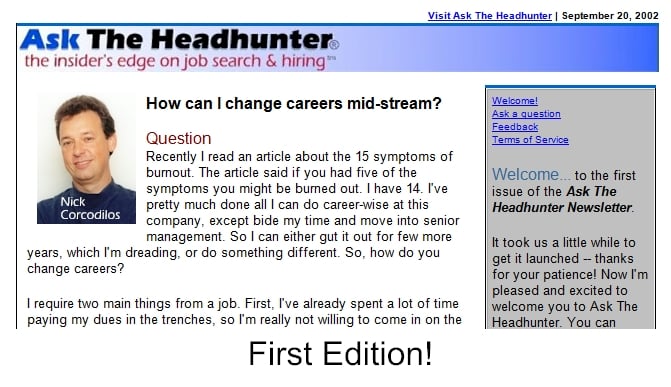
    The September 25, 2012 Ask The Headhunter Newsletter is a SPECIAL EDITION celebrating the 10th Anniversary of the newsletter! I’ve culled four of the top Q&As readers have cited among their favorites from past editions. I had fun summarizing them, and whether you’re a charter subscriber from 2002, or relatively new to Ask The Headhunter, I hope you learn something new and useful!

    UPDATE: Coincidental with this edition, PBS NewsHour — Making Sen$e with Paul Solman – aired a segment yesterday that I taped with them at Wharton School of Management. The video is now posted here: PBS NewsHour: Online job applications keep America unemployed. The lead-up article I wrote for this is also on NewsHour online: Six Secrets to Beat the Job Market.
    Want to be on PBS NewsHour? (You can use a screen name, of course!) As part of this PBS project, I’m taking questions from viewers! Submit questions on Paul Solman’s PBS NewsHour Q&A. I intend to answer every question submitted on the PBS website! Please post questions on the comments section of the blog. The more questions you post, the more Q&A ATH columns will appear on NewsHour! Keep ‘em coming!

    (I started the newsletter on September 20, 2002 — 10 years ago! You’re reading issue #449! Many of you have been reading since issue #1, and today there are tens of thousands of subscribers — and not just job hunters.)

    Top Question 1: “Why are you leaving your old job?”

    I began a job search this week. I’ve read so many suggestions about how to answer this question that I am not sure about it any more. I have an interview coming up. Can you please give me some advice about what to say when I’m asked the reasons I am leaving my current job?

    Nick’s Reply

    The real problem with this question is that you have no way of knowing the interviewer’s intent. And it’s not worth guessing and being wrong. If you believe that explaining your reasons for leaving your last job will reflect well on you, then by all means explain. If you’re worried the details could hurt you, then try this:
    How to Say It
    “I love my work, and I want to work in a better company where I am free to do my job effectively.”
    If they ask you what the problem is with your current employer, be honest but turn the discussion to what really matters:
    How to Say It“I’m looking for a good job with a good company, but I never disparage anyone I’ve ever worked with. I came to you because your company is one of the shining lights in this industry, and I’d like to talk about how I can help you be more profitable. Can you give me an idea of what problems or challenges you’d want the person that you hire to tackle? I’d like to show you how I’d do that.”
    That’s the best way I know to approach any employer, and to get past that question. Focus on the company you’re meeting with, not on your past or your old company. Explain how you’re going to help them be more successful. That’s what any good employer is really looking for. (Learn more inThe Basics.)

    Top Question 2: How can I get the truth about a job?

    When I interviewed for my job, I was told that the person who hired me would be my boss. It turns out that I actually report day-to-day to someone else. If I had interviewed with this person, I would have kept looking for another job! I am working on a team that is abusive and for a boss who is unsupportive and disrespectful. I saw none of this in my interviews. You can’t fix that for me, but what I’d like to know is how to avoid this in the future. How can you really find out about the work environment and culture? A Google search (done too late) revealed some of the problems I discovered later. This company displayed a wonderful “we-are-so-caring-and-ethical” face, but the reality is quite different. Thanks!

    Nick’s Reply

    It’s called due diligence. Never take a job without investigating the company and its people. After you receive an offer, turn around and interview the company. Politely insist on meeting your future boss and the team, as well as others that you will interface with on the job. This includes people who will work directly with you; people who work uphill and downhill from your job function; and people in other departments who will influence your ability to succeed at your job.
    For example, if you work in information technology, meet folks in manufacturing and accounting. Your work will affect both departments, and your fate will be influenced by how they operate. Your meetings will tell you about the viability of the company, and you will learn about the personalities of the players. Add up the personalities, and you will get the company culture. Company culture is hiding in cubicles and in meetings.
    Ask to sit in on a department or team meeting before you accept the offer. Spend half a day shadowing a couple of your future co-workers. Make sure this includes lunch time, where people loosen up and talk. That’s the only way to really get at a company’s culture firsthand. Never take a job without knowing “the rest of the story.” Savvy companies set up these meetings for you. They recognize savvy candidates who are willing to invest time to get to know the people and the operation.

    Top Question 3: Do I have to say it?

    When I was job hunting, I always made it clear that I wanted the job. As a hiring manager, I want to ensure that positions are filled by qualified candidates who I know, undisputedly, want the job. Can you discuss the importance of this basic and obvious technique in interviewing that is often overlooked? That is, the applicant must always say to the potential employer, “I want this job.”

    Nick’s Reply

    A sales VP who interviewed for a job and failed to get an offer told me that making such an explicit statement is awkward and that it shows the candidate “has no class.” My response: Failure to say you want the job indicates you don’t have enough interest in working for the employer.
    “The manager knows I want the job!” he exclaimed. “That’s why I’m interviewing!”
    Interesting, isn’t it, how socially unacceptable some people believe it is to make an explicit commitment when that’s exactly what an employer needs to hear. When I first started headhunting, a manager turned down an excellent candidate I sent him — and I couldn’t figure it out. So I asked, and the manager was crystal clear: “He’s a talented guy, but I’m just not convinced he really wants to work for me.” This prompted me to coach every candidate to say it.
    Consider this very appropriate analogy. You fall in love and want to marry the object of your desire. If you don’t explicitly say, “I love you,” do you think the person will marry you? The commitment must come first. You have to say it.

    Top Question 4: How can I demonstrate my value?

    I think you’re right: To get a company interested in me, I need to demonstrate and somehow quantify what my value is to them. But if I’m not a salesperson or entertainment star, how do I quantify my value to an employer’s bottom line?

    Nick’s Reply

    Here’s my general approach: Estimate as best you can how your work produces revenue or reduces costs. If you work in sales or product design, you help produce revenue in your job by selling or by creating products. That’s good for the company. The more you enhance the revenue-producing process, the more value you add to the business. If you work in finance or in manufacturing, you have a daily impact on the company’s costs. High costs are not good. Your job contributes to the success of the business by helping minimize costs.
    The difference between revenue and cost is profit. No matter which part of the company you work in, you can help boost profits by doing your part to raise revenue or lower costs. Regardless of what your job is, ask yourself how you do it to enhance profits. Do you sell more stuff at higher margins, or do you do some other job smarter, faster, and cheaper? That’s your edge.
    Estimate your impact to the bottom line. Can you shave two minutes off each customer service call you handle? Can you figure out a way to get a project done 20% faster? Multiply it out by the rate you get paid. That’s just one part of the profit you’ve contributed to the business. Get the idea? Yes, I’m simplifying, but any calculation like this that you do is more than any other candidate will even attempt. It gives you a good, honest story to tell the employer. It gives you an edge.
    (Want to learn more about how to reveal your value? Check out my PDF book, How Can I Change Careers? It’s not just for career changers, but for anyone who wants to stand out in a job interview. Learn how to prove to an employer that you would be a profitable hire. Plus: Learn how to pick the handful of companies you should really pursue, and how to become the candidate on the inside track for the job you want.)
    Have something to say about these top questions — and my advice? Have a question of your own to ask? Bring it on and we’ll tackle it! Please post away in the Comments section below!
    : :
     

    10th Anniversary Special: 4 Top Answers from The Archive | Ask The Headhunter® | Nick Corcodilos

    'via Blog this'